Simulation outputs
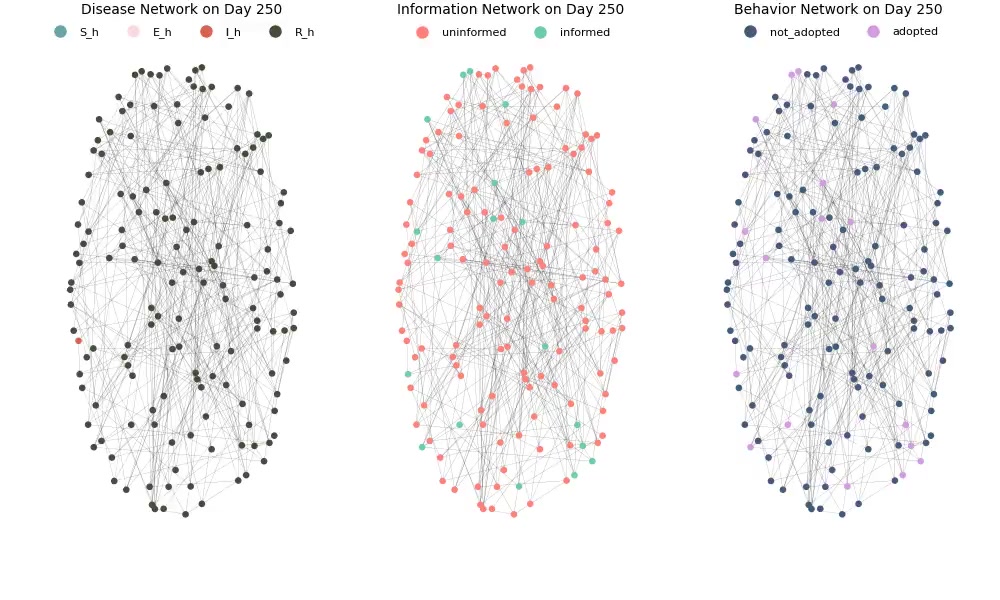
For visualization purposes, we are demonstrating the diffusion of
dengue, information about dengue, and health adoption against dengue
with a smaller sample size.
Dengue transmission and information diffusion parameters
| Parameters | Descriptions | Values | Sources |
|---|---|---|---|
\(\nu_h\) |
Transition rate from exposed to infectious state for humans | 1/5 days-1 var = 0.001 |
Manore et al., 2015 |
\(\mu_h\) |
Transition rate from infectious to recovered state for humans |
1/6 days-1 var = 0.001 |
Manore et al., 2015 |
\(\psi_v\) |
Natural per capita emergence rate of female adult mosquito emergence | 1/3 | Manore et al., 2015 |
|
\(\mu_v\) |
Natural death rate of mosquitoes | 1/40 | Andraud et al., 2012 |
|
\(\nu_v\) |
Transition rate from exposed to infectious state for mosquitoes | 1/8 days-1 | Manore et al., 2015 |
|
\(\sigma_v\) |
Maximum times one mosquito bite human per day | 1/2 | Manore et al., 2015 |
|
\(\sigma_h\) |
Maximum mosquito bites human can sustain per day | 19 | Manore et al., 2015 |
|
\(\beta_{hv}\) |
Transmission probability between infectious mosquito and susceptible human | 0.50 | Andraud et al., 2012 |
|
\(\beta_{vh}\) |
Transmission probability between infectious human and susceptible host | 0.75 | Andraud et al., 2012 |
|
\(e\) |
Mosquito death rate from pesticide use | 0.50 | Khan et al., 2021 |
|
\(K_v\) |
Mosquito carrying capacity | 5000 | Baseline value |
|
\(N_h\) |
Total human population | 1000 | Baseline value |
| Initially infected | Percent of initial infected population | 0.05 % | Baseline value |
| Edge probability | Probability two agents connect | 0.03 % | Baseline value |
| Simulation period | Simulation period run-time | 200 days | Baseline value |
| Human time step | Time step for agent-based model simulation | 0.25 days | Baseline value |
| Mosquito time step | Time step for ODE model | 0.005 days | Baseline value |
Attributes of individual agents
| Attributes | Descriptions | Values |
|---|---|---|
| Disease State | Agent occupies one of four disease states | Susceptible, Exposed, Infectious or Recovered |
| Symptomatic Status | Agent has dengue symptoms | True or False |
| Information State | Awareness of dengue circulation | Uninformed or Informed |
| First Informed | Time when agent becomes informed of dengue circulation | Integer |
| DART Informed | Number of times informed by DART | Integer |
| Talk Informed | Number of times informed by word-of-mouth communication | Integer |
| Total Informed | Total number of times informed of dengue circulation | Integer |
| Behavior State | Adoption of health-protective behavior | Adopted or Not Adopted |
| Adoption Threshold | Willingness to adopt health-protective behavior once informed | 0 to 1 |
| Mosquito Contact Reduction Efficacy | Intensity of behavior adoption when reducing mosquito contact | 0 to 0.7 |
| Insecticide Efficacy | Intensity of behavior adoption when using insecticide | 0 to 0.8 |
References
- Anders, K.L., Nguyen, M.M.N., Tran, T.T.H., Simmons, C.P., Farrar, J., Chau, N.V.V., Wills, B., Thuy, T.T., Hung, N.T., Lien, L.B.: Epidemiological Factors Associated with Dengue Shock Syndrome and Mortality in Hospitalized Dengue Patients in Ho Chi Minh City, Vietnam. Am. J. Trop. Med. Hyg. 84(1), 127-134 (2011).
- Bosch, Q.A.t., Clapham, H.E., Lambrechts, L., Duong, V., Buchy, P., Althouse, B.M., Lloyd, A.L., et al.: Contributions from the Silent Majority Dominate Dengue Virus Transmission. PLoS Pathog. 14(5), e1006965 (2018).
- Morin, C., Semenza, J., Trtanj, J., Glass, G., Boyer, C., Ebi, K.: Unexplored Opportunities: Use of Climate- and Weather-Driven Early Warning Systems to Reduce the Burden of Infectious Diseases. Curr. Environ. Health Rep. 5, 430-438 (2018).
- Aguiar, M., Anam, V., Blyuss, K.B., Estadilla, C.D.S., Guerrero, B.V., Knopoff, D., Kooi, B.W., Srivastav, A.K., Steindorf, V., Stollenwerk, N.: Mathematical models for dengue fever epidemiology: A 10-year systematic review. Phys. Life Rev. 40, 65-92 (2022).
- Bobashev, G., Goedecke, D., Yu, F., Epstein, J.: A Hybrid Epidemic Model: Combining The Advantages Of Agent-Based And Equation-Based Approaches. In: Winter Simulation Conference (2007). pp. 1532-1537 (2007).
- Mao, L.: Modeling triple-diffusions of infectious diseases, information, and preventive behaviors through a metropolitan social network—An agent-based simulation. Appl. Geogr. (Sevenoaks, England) 50, 31-39 (2014).
- Manore, C., Hickmann, K., Hyman, J., Foppa, I., Davis, J., Wesson, D., Mores, C.: A network-patch methodology for adapting agent-based models for directly transmitted disease to mosquito-borne disease. J. Biol. Dyn. 9, 52-72 (2014)